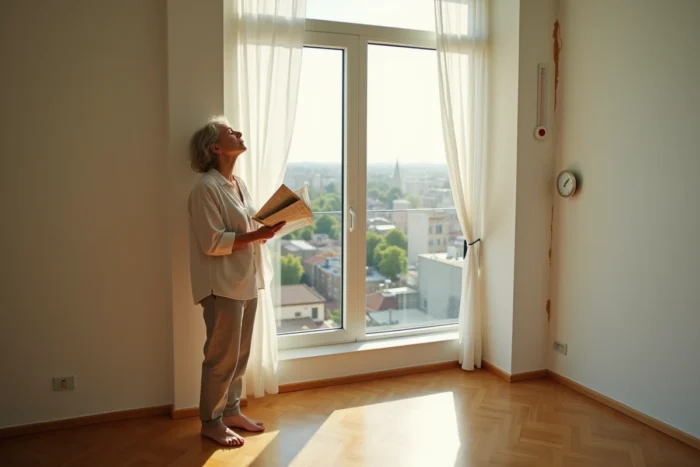
In a multi-story house or a collective building, the temperature difference between the ground floor and the upper levels can reach several degrees during the summer. This observation, seemingly trivial, is based on physical and construction mechanisms that accumulate, some of which are exacerbated by recent insulation choices.
Thermal stratification and the capacitive effect of materials at height
Competitors extensively address natural convection (warm air rises) and solar radiation on the roof. These two factors are real, but they only explain part of the problem. A less frequently described phenomenon plays a crucial role: the thermal inertia of materials located in the upper part of the building.
Concrete slabs, load-bearing walls, tile or slate roofs accumulate solar heat during the day. At night, these materials release this energy by radiation into the interior of the rooms. Building thermal engineers compare this functioning to that of a sponge: the building absorbs heat and takes several days to discharge it, even when the outside temperature drops.
This radiation is perceptible regardless of the ambient air temperature. One can air-condition an attic room and still feel intense heat because the walls and the slab are still radiating. To understand heat by floor, it is therefore necessary to distinguish between air temperature and perceived temperature, which largely depends on the radiation from surrounding surfaces.
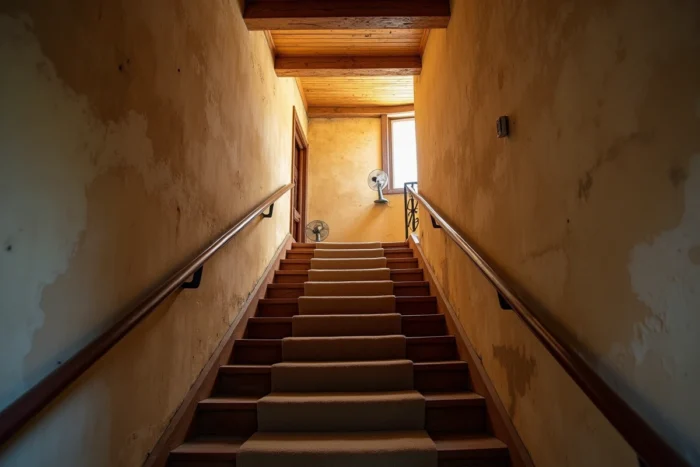
Enhanced thermal insulation: why it can worsen overheating in summer
Recent regulations impose high insulation levels for roofs and attics. The primary goal is to limit heating losses in winter. In summer, the logic partially reverses.
A well-insulated roof prevents outside heat from entering quickly, which is positive during the first days of a heat wave. However, without fine management of solar gains and ventilation, this insulation traps indoor heat. The heat produced by occupants, electrical devices, and solar radiation through windows accumulates in a closed volume, with no easy way to escape to the outside.
An article from Le Monde in July 2026 describes thermal insulation as “counterproductive” in the face of prolonged heat waves when not accompanied by external solar protections and appropriate ventilation. This observation is shared by several building professionals: a well-insulated but poorly ventilated home turns into an oven by the third day of a heat wave.
The cumulative effect of successive heat waves
Field data show that the temperature gap between the ground floor and the upper floor becomes significantly more pronounced at the end of a heat wave than at the beginning. The mass of the building has not had time to discharge between two episodes, and the indoor temperature on the top floor continues to rise even after the external peak has passed.
This phenomenon explains why some recent homes, despite complying with energy standards, become more difficult to live in during the summer than older buildings with thick stone walls and solid shutters.
Roof, attic, and windows: the three areas that concentrate heat gains
The overheating of upper floors results from the overlap of several thermal entry points. Three of them concentrate the majority of solar gains in summer.
- The roof receives solar radiation over a large area and for most of the day. Its color, material, and insulation determine the amount of heat transmitted to the attic and the rooms just below.
- The attic, when poorly ventilated, acts as a reservoir of warm air. The temperature under the roof can far exceed that of the outside air, and this mass of overheated air radiates towards the floor of the rooms below.
- The upper floor windows, often oriented to capture afternoon sun, allow direct solar radiation to enter. The absence of external solar protections (shutters, sunshades, awnings) multiplies thermal gains through the glazing, much more than a lack of wall insulation would.
The hierarchy among these three areas varies depending on the configuration of the home, but in most cases, the roof and glazing are responsible for the majority of summer overheating on the upper floors.
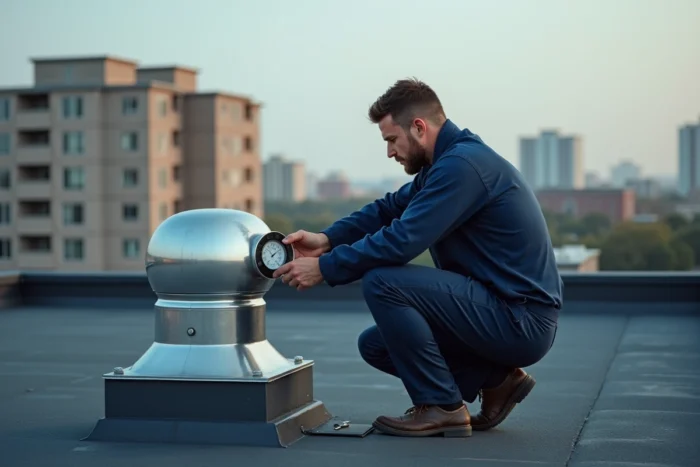
Night ventilation and solar protections: the truly effective levers
In light of this observation, the most commonly cited solutions (air conditioning, fans) address the symptom without tackling the cause. Field feedback converges on two priority levers.
External solar protections on windows
An interior blind or curtain allows solar radiation to pass through the glazing and then tries to block it once it’s already in the room. Only an external protection (shutter, sunshade, awning) prevents radiation from reaching the glazing. The difference in effectiveness between interior and exterior protection is significant.
Night over-ventilation to purge thermal inertia
Opening windows wide at night, creating a cross-draft (windows open on two opposite facades), allows for cooling of the masonry masses accumulated during the day. This technique of cross-ventilation at night is even more effective when the temperature difference between day and night remains significant.
The goal is not to cool the ambient air (it will warm up again the next morning) but to discharge the walls, slabs, and roof of their stored heat, so that the radiation from the walls is less intense the following day.
- Close shutters and windows as soon as the outside temperature exceeds the inside temperature (usually mid-morning).
- Open wide as soon as the outside temperature drops below the inside temperature (often after 10 PM in summer).
- Prefer openings on two opposite facades to create natural draft, rather than a single open window which does not generate air flow.
During prolonged heat waves where nighttime temperatures remain high, this strategy loses effectiveness. Available data do not guarantee a result in all cases, and field feedback varies on the actual gain depending on the type of building. Nevertheless, the combination of external solar protections and night over-ventilation remains the most coherent duo to limit overheating of the upper floors without resorting to air conditioning.