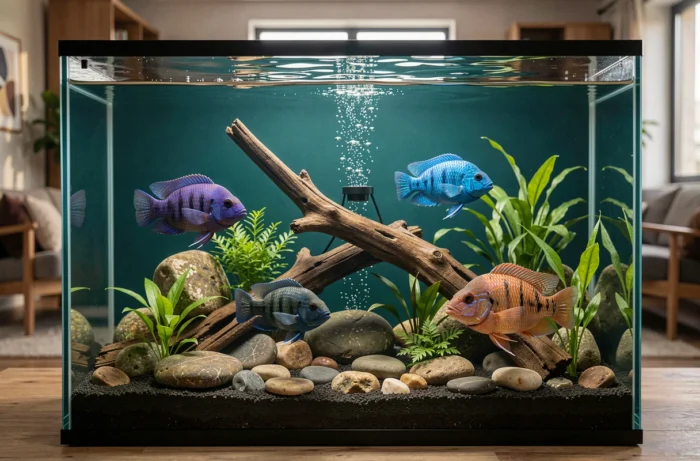
Cichlids are one of the largest families of freshwater fish in the world. Their diversity of shapes, colors, and behaviors attracts both beginner aquarists and seasoned enthusiasts. However, this richness hides a trap: not all cichlids can be kept in the same way, and a poor choice of species can quickly turn the aquarium into a zone of permanent conflict.
Choosing a cichlid based on your aquarium and experience
Before you fall for a fish at the pet store, ask yourself a simple question: what volume of water do you actually have available? The answer determines everything else.
A tank of less than 200 liters points towards South American dwarf cichlids, such as Apistogramma or Mikrogeophagus ramirezi. These species take up little space, tolerate soft and slightly acidic water, and coexist with other small, calm fish.
From 300 liters onward, African cichlids from Lake Malawi become feasible. Mbuna, for example, are robust and colorful, but their territorial temperament requires suitable decor and a sufficiently large group. A beginner aquarist who places two or three Mbuna in a tank that is too small will quickly find that the dominant one relentlessly harasses the others.
For larger species (Oscars, Tanganyika cichlids like Frontosa), a significantly larger volume is required. The tank volume determines the possible species, not the other way around. Consulting detailed profiles on cichlidae.be helps identify the specific needs of each species before purchase.
Decor and territories: reducing cichlid aggression
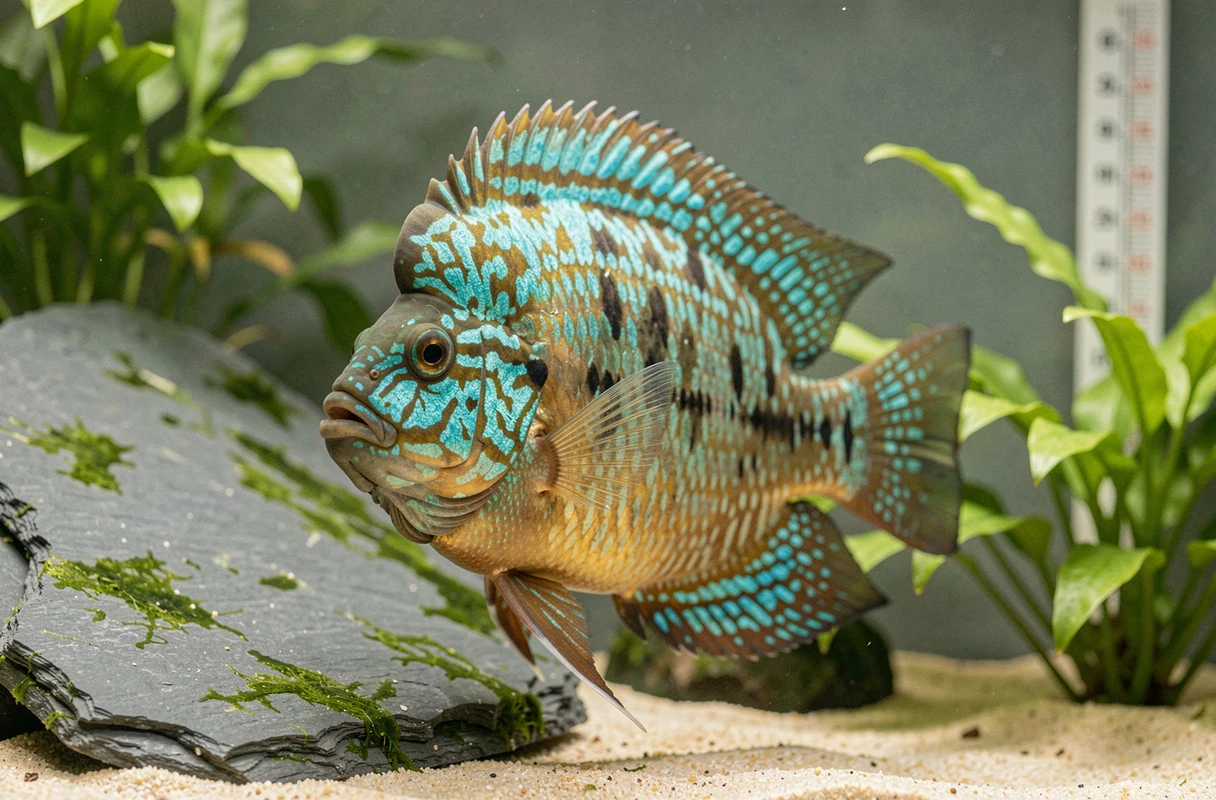
Have you ever noticed that a calm cichlid in the store becomes aggressive once at home? The aquarium’s decor is often the direct cause.
For cichlids, territory is not limited to a corner of the tank. It is a visual area. As long as a fish sees a competitor, it considers it an intruder. Breaking the lines of sight with decor reduces aggression much more than simply adding hiding spots.
Building effective decor
The idea is not to stack rocks randomly. Each rock pile or root should create a visual barrier between two areas of the tank. A Mbuna that cannot see its neighbor will not chase it.
- Arrange the rocks in several separated clusters rather than a single central mass to multiply distinct territories.
- Provide at least as many hiding spots as there are fish, varying the sizes of openings so that each individual finds a suitable refuge.
- Avoid large open areas in the center of the tank: they become chase corridors that the dominant fish patrols constantly.
For South American dwarf cichlids, replace the rocks with roots, dead leaves, and dense vegetation. These species prefer a shaded environment that limits stress.
Controlled overpopulation: a counterintuitive strategy for Mbuna
Adding more fish to a tank to reduce aggression seems absurd. Yet, it is a documented method for certain African cichlids, particularly the Mbuna from Lake Malawi.
The principle is simple: a dominant fish cannot harass a single target when the pressure is spread across a large group. Its attention disperses, and conflicts remain brief.
This approach only works under two conditions. First, the tank volume must be sufficient to accommodate the additional biological load. Secondly, the filtration must be sized beyond the nominal volume of the aquarium. A filter designed for a standard tank will quickly be overwhelmed by the amount of waste produced.
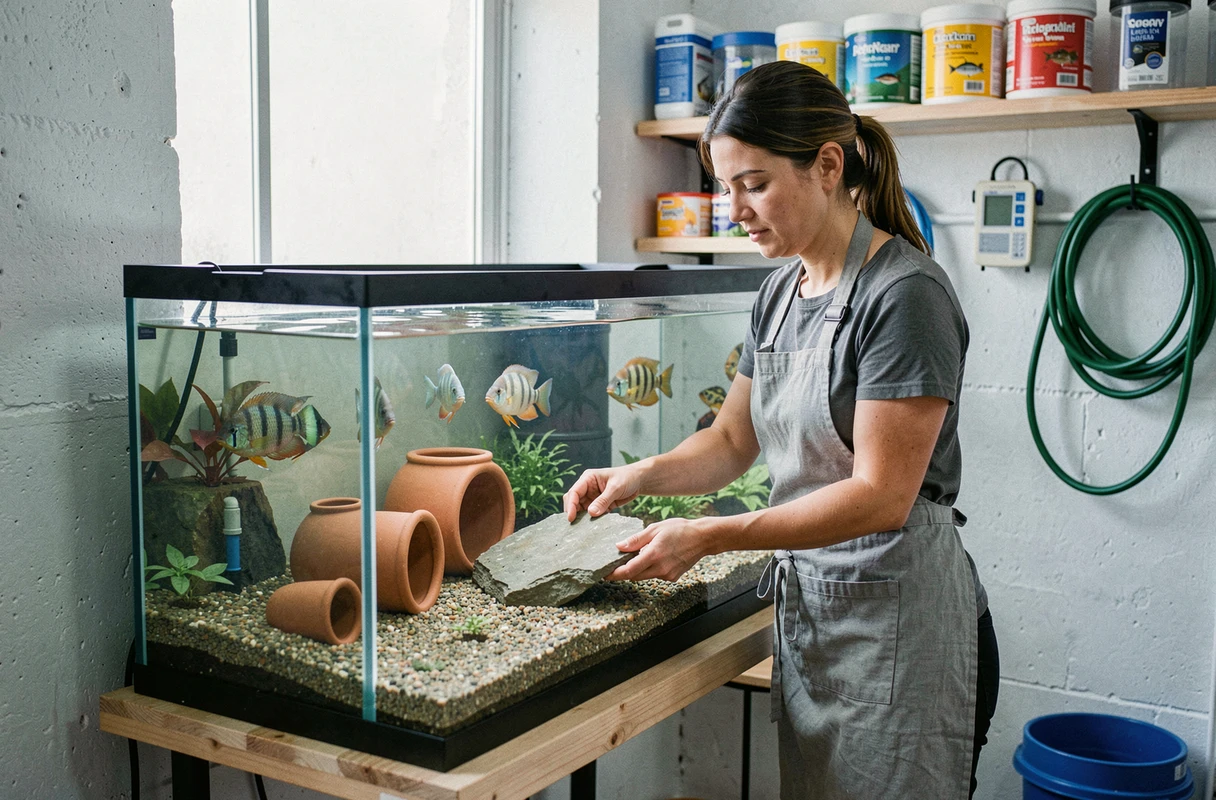
Regular and generous water changes complement the setup. Without this discipline, nitrates rise, and fish develop chronic pathologies. Controlled overpopulation is a tool, not a shortcut.
Cichlid feeding: adapting the diet to the group
Feeding all your cichlids the same food is a common mistake. The needs vary significantly from one species to another, even among fish from the same lake.
Herbivores, omnivores, carnivores: three distinct profiles
Malawi Mbuna are primarily algae grazers. Their long digestive tract, adapted to plant material, does not handle excess animal protein well. A diet too rich in protein causes “Malawi bloat”, an abdominal swelling that is often fatal.
- For grazers (Mbuna, Tropheus from Tanganyika), prioritize foods based on spirulina and plant materials, with limited protein content.
- For omnivores (Aulonocara, Haplochromis), alternate between varied pellets and occasional supplements like bloodworms.
- For predators (Nimbochromis, some Central American cichlids), a higher protein intake is necessary, based on shrimp, mussels, or enriched pellets.
In all cases, distribute small portions that the fish consume in a few minutes. One fasting day per week promotes digestion and limits waste accumulation in the tank.
Filtration and water quality in a cichlid tank
African cichlids live in waters with parameters different from regular tap water. The temperature should remain stable, between 25 and 27 °C for species from the Great Lakes. Sudden fluctuations are more dangerous than a slightly off value.
Alkaline pH and high hardness (GH and KH) characterize Lakes Malawi and Tanganyika. For South American dwarf cichlids, it’s the opposite: soft water, slightly acidic pH.
Testing tap water before choosing your species avoids permanent chemical adjustments. If your water is naturally hard and alkaline, it is suitable for African cichlids without manipulation. If it is soft, South Americans will adapt better.
For filtration, aim for a capacity greater than the actual volume of the tank. Cichlids produce a high organic load, especially during breeding when activity and stress increase. An external filter with generous flow and quality biological filter media is the foundation of a stable tank in the long term.
Keeping cichlids is not just about filling a tank and adding fish. The choice of species, the design of the decor, the population density, and the adjustment of the diet form a coherent whole. Each decision made in advance prevents a problem later on, and it is precisely this preparatory work that makes maintaining these fish as rewarding as it is challenging.