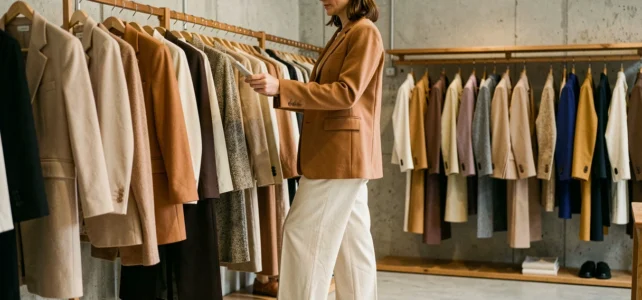
A bomber worn three days in a row without fatigue, a tapered pant that replaces the straight jean in the weekly rotation, a tweed scarf brought out as soon as the first cool mornings arrive: the fashion trends of this season are first tested on the streets, not on a runway. We have identified the pieces that truly deliver on their promises in everyday life, those that integrate into an existing wardrobe without completely upheaving it.
Tweed and bomber: two pieces that change the autumn-winter silhouette
Tweed is making a comeback with an intensity that the Tagwalk search data largely confirms. It can be found on short jackets, pencil skirts, and even accessories. Its thick texture structures an outfit effortlessly, even when paired with a simple white t-shirt.
The bomber, on the other hand, has moved away from its sportswear roots. Current versions play with heavier fabrics, contrasting ribbed collars, and slightly oversized cuts that work just as well over a midi dress as they do over cargo pants. You can find fashion trends on EpicBuzz to identify variations that work according to body shapes.
Pairing a bomber with a pencil skirt creates a contrast that modernizes both pieces. It achieves a balance between structure and relaxation that neither a blazer nor a trench can produce in the same way.
Tapered pants and fitted cuts: the return of body-hugging silhouettes
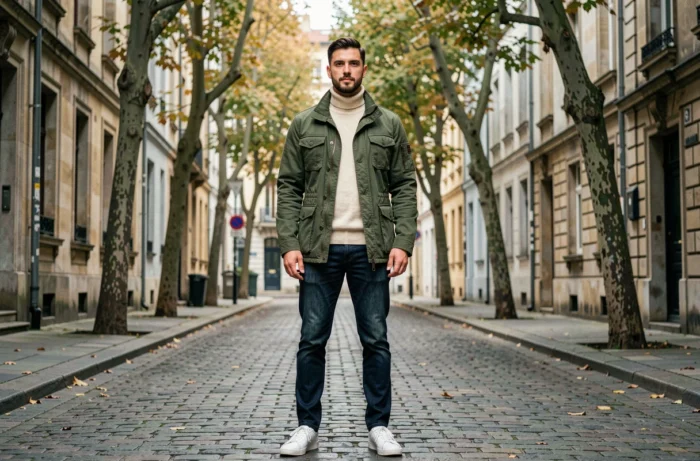
After several seasons of wide cuts (barrel, wide-leg, palazzo), tapered pants are regaining ground. The cut is fitted at the calf, sometimes slit at the ankle, and creates a clean line that visually elongates the leg.
On the ground, it is observed that this piece works best with pointed-toe shoes or flat ankle boots. Bulky sneakers, on the other hand, disrupt the proportion. Feedback varies on this point depending on the rise of the tapered pants, but high-waisted tapered pants with a low-cut ankle boot remain the most reliable combo.
How to integrate tapered pants without a retro effect
The risk with tapered pants is the overly literal association with the codes of the 1960s. To avoid this, they should be worn with deconstructed tops: an open linen shirt, an oversized sweater falling below the hip, a bomber zipped to mid-chest.
Color also matters. Black or charcoal tapered pants work everywhere. Colored versions (burgundy, forest green) require a neutral top to avoid overwhelming the outfit.
Animal prints and autumn patterns: balance without saturation
Animal print remains a strong signal this season. Leopard, snake, zebra: the patterns circulate on blouses, scarves, and bags. The classic trap is to put them everywhere and turn the outfit into a costume.
One animal print piece per outfit is enough to create a focal point. It should be combined with muted colors (black, camel, gray) to let the pattern breathe without competing with the rest.
- Leopard scarf on a solid coat: the pattern catches the eye without dominating the silhouette, and it can be removed if the context requires.
- Snake-effect leather bag worn with a monochrome outfit: it becomes the central accessory without any effort in coordination.
- Animal print blouse tucked into high-waisted pants: the framing by the belt contains the pattern and structures the upper body.
Extra-long sleeves and upper volumes: what changes concretely
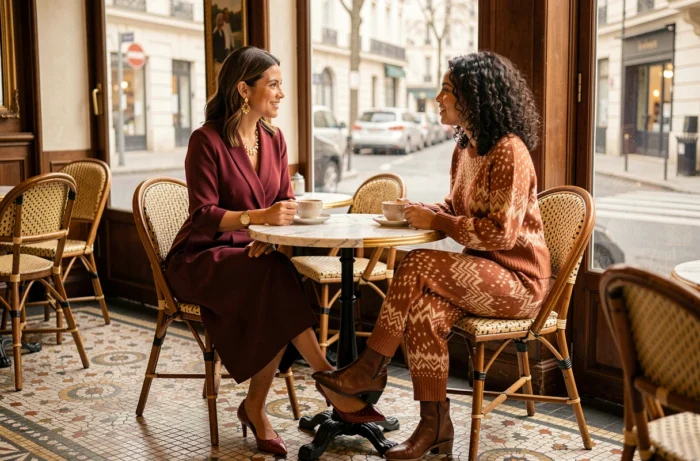
Long sleeves that extend beyond the wrist are not just a runway detail. They can be found on sweaters, knit dresses, and certain coats. The visual effect is immediate: the silhouette appears more fluid, more nonchalant.
In practice, extra-long sleeves work best on soft knit pieces that move with the arm’s motion. On a rigid fabric (gabardine, thick cotton), the elongation creates a cardboard effect that feels unnatural.
Seasonal colors: focus on durability rather than disposability
Autumn-winter palettes revolve around deep shades: burgundy, fir green, midnight blue, camel. These colors transcend seasons without going out of style, coinciding with an underlying movement in the industry.
The European Union has banned the destruction of unsold clothing and shoes by large companies since July 2026. This regulatory constraint pushes brands to produce pieces designed to last several seasons. Choosing timeless colors becomes both a stylistic gesture and consistent with market reality.
Bright colors do not disappear either. They are used as accents: a pair of red gloves, a yellow beanie, an orange belt. The principle remains the same as for animal prints: a strong color point on a neutral base.
Chic style and authenticity: building a seasonal wardrobe that lasts
This season’s consumer signals point towards comfort, authenticity, and durable pieces rather than constant novelty. In practical terms, a seasonal wardrobe is built around a few axes:
- Three to four strong pieces (bomber, tapered pants, tweed scarf, structured bag) that define the season’s style without requiring a complete overhaul.
- Quality basics in natural materials (wool, thick cotton, linen for mid-seasons) that serve as a foundation for outfits.
- One or two accessories with patterns or bright colors to vary combinations without multiplying purchases.
An effective seasonal wardrobe can be condensed into about ten well-chosen pieces. The rest are combinations. A bomber over tapered pants one day, over a midi dress the next, with a tweed scarf or without: the possibilities multiply without increasing the volume of clothing.
This season’s fashion rewards those who invest in precise cuts and solid materials rather than accumulation. A well-cut tapered pant, a bomber in dense fabric, a genuine tweed scarf: these pieces will carry through the winter and remain relevant for the next season.