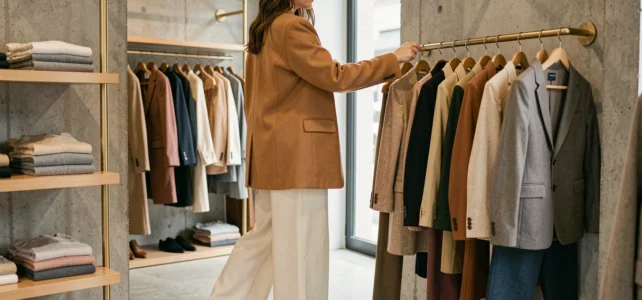
The European regulation on unsold textiles, environmental claims, and garment traceability redefines what brands can promise and display. Understanding these changes allows one to distinguish a genuine fashion trend from a mere marketing argument.
European Regulation and Fashion: What Changes for Brands Starting This Season
Since the summer of 2026, the European Union prohibits brands from destroying their unsold clothing. This measure, stemming from the eco-design regulation, directly affects stock management and collection cycles.
At the same time, the Green Claims Directive regulates the terms a brand can use to qualify its products. Terms like “eco-friendly,” “sustainable,” or “conscious” must now be backed by verifiable evidence. A garment can no longer be presented as “green” without specific justification.
The other major initiative concerns the digital product passport, a system intended to document the composition, repairability, and end-of-life of each garment. Its implementation is expected to begin in 2027-2028, but brands anticipating this standard are already adapting their product sheets and communications. To follow all the news on Moderne Mode, these regulatory developments are among the topics to watch closely.
This regulatory framework has a concrete effect on trends: collections are becoming more streamlined, brands are producing fewer references, and focusing on long-lasting pieces rather than disposable micro-trends.

Autumn-Winter 2026 Trends: The Key Pieces Structuring the Wardrobe
The autumn-winter season is built around a few recurring silhouettes on the runways and in pre-collections. The wardrobe is refocusing on reworked basics rather than on spectacular one-time-use pieces.
Wide Trousers and Structured Jackets
Wide-cut trousers remain a staple of style this season. Pleated models, made of wool or thick cotton, are gradually replacing skinny jeans in wardrobes. Paired with a short, structured jacket, it creates a look that works well both in the office and outdoors.
The short jacket becomes the key piece of autumn 2026. Versions in tweed, leather, or thick denim dominate the offerings from brands, from H&M to luxury houses.
Return of Heavy Textures and Layering
Thick materials (cable knit, corduroy, raw denim) are making a strong comeback. Layering, a classic of autumn-winter, takes on a more functional dimension this season: each added piece must have a real utility, not just a visual effect.
- The midi knit dress worn over a fine turtleneck, a combination that allows for heat modulation without sacrificing silhouette.
- The trench or lightweight parka used as an intermediate layer under a heavier coat, an approach that extends the usage duration of each garment.
- Thick leather accessories (wide belts, structured bags) that anchor a look made up of soft pieces.
Second Hand and Resale: A Shopping Reflex Redefining Fashion Shopping
Second hand has changed its status. It is no longer a parallel circuit reserved for bargain hunters. Buyers, especially younger ones, systematically compare resale prices before purchasing new. This reflex encourages consumers to prioritize pieces whose value remains stable in the second-hand market.
The RealReal’s report for 2026 shows a notable increase in demand for vintage pieces. This phenomenon goes beyond mere retro appeal: it reflects a search for uniqueness in a market saturated with identical collections.
Brands Launch Their Own Resale Platforms
Rather than leaving resale to third-party platforms alone, more and more brands are creating their own resale circuits. This hybrid model, combining new and second-hand on the same site, modifies the relationship between the brand and the consumer.
The brand’s interest is twofold: controlling the resale price of its products and extending the perceived lifespan of each piece. For the consumer, this simplifies the shopping journey by concentrating new and second-hand items in one place.

Green Claims and Labeling: Analyzing Product Sheets This Season
The European directive on green claims imposes a change in vocabulary for brands. Generic terms (“eco-friendly,” “green,” “responsible”) without measurable proof are now subject to sanctions. This is not a compliance detail: it directly alters what the consumer reads on a product sheet or label.
Specifically, a brand claiming a percentage of recycled material must be able to certify it through a third-party organization. Fashion labeling becomes an exercise in regulatory precision, not storytelling.
- Check for the presence of a recognized certification (GOTS, OEKO-TEX, GRS) rather than relying on a proprietary logo invented by the brand.
- Read the full composition: a garment “in organic cotton” may contain a significant portion of synthetic fibers if only the main material is certified.
- Beware of “sustainable” capsule collections that represent a marginal fraction of a brand’s total production.
The anti-fast fashion penalty, which came into effect on September 1, 2026, in France, adds an additional layer. Low-cost brands see their products financially penalized, which slightly balances the price gap with brands producing in more reasonable volumes.
This season, the most significant fashion trend is not about what you wear: it is reflected on a label, in a product sheet, or in the terms and conditions of a resale platform. A certified garment, with transparent composition and integrated into a resale circuit, retains its relevance well beyond a single season.