
When hosting six or eight people on a Saturday night, the question of beverage supply quickly arises. Buying several packs of different beers clutters the fridge, and not everyone drinks the same thing. Mixed kegs for beer machines solve this problem in one go: one machine, one keg ready to serve, and a light drink that more or less satisfies everyone.
Reduced alcohol content and managing the evening: what the mixed draft really changes
The impact of a lower alcohol content on the actual flow of an evening is often underestimated. A mixed drink, by definition, combines beer and lemonade. The result is a beverage that is significantly less alcoholic than a standard beer.
In practice, this means that glasses get filled more often without the evening spiraling out of control. Conversations remain fluid, no one falls asleep on the couch at 11 PM, and the question of driving home arises with less tension. For a host, this is a real comfort factor.
The mixed draft is also suitable for guests who limit their alcohol consumption without wanting to end up with a glass of water. Offering mixed drinks includes moderate drinkers without isolating them. It avoids the binary “beer or nothing” situation that leaves some guests on the sidelines.
Choosing mixed kegs for beer machines aligns with a broader trend observed in the French market: lighter, lower-alcohol, or non-alcoholic ranges are on the rise, driven by a demand for freshness and moderation.
Mixed keg versus bottles: the real calculation for a home evening
The comparison is not limited to price per liter. We must consider the complete logistics: transport, storage, cooling, serving, and cleaning.
Logistics and clutter
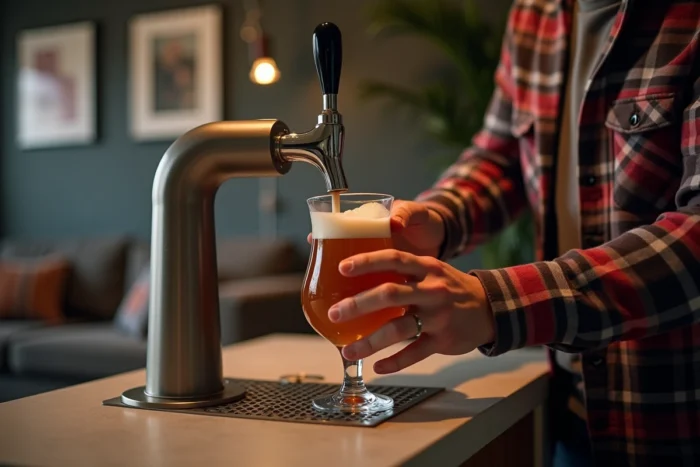
A mixed keg fits in the beer machine, plugged into the countertop. No need to monopolize two shelves of the refrigerator with packs of cans or bottles. No caps lying around everywhere, no empty crates to store until the next trip to the recycling center.
Individual bottles also pose a temperature problem. When you open the fridge every ten minutes to grab one, the internal temperature rises and the rest of the contents suffer. A keg in its machine stays at a constant serving temperature.
Waste and recycling
A keg replaces dozens of bottles or cans. At the end of the evening, you collect one container instead of a whole bag of glass or aluminum. For those concerned about reducing their packaging waste, the difference is concrete and visible the next morning.
- A standard keg replaces the equivalent of several dozen individual bottles, drastically reducing the volume of waste to sort.
- The empty keg can be recycled in one operation, unlike the caps, labels, and glass separated from bottles.
- Less handling also means less risk of breakage, especially at the end of the evening.
Taste and freshness of the mixed draft: what changes compared to a homemade mix
Mixing beer and lemonade in a glass yourself is something everyone has done. The result depends on the dosage, the temperature of both components, and when you mix them. In short, it’s random.
A ready-to-draw mixed keg offers a calibrated dosage for each glass. The beer/lemonade ratio remains the same from the first to the last serving. The carbonation is consistent because the mixture was made in advance, under controlled pressure.
The taste is directly affected. A homemade mix tends to go flat after a few minutes because the lemonade loses its bubbles when in contact with the beer already served. On draft, the drink comes out of the keg with its carbonation intact. You get a light foam, constant fizz, and lemonade notes that don’t fade at the bottom of the glass.
Feedback varies on the taste difference depending on the keg brands, but the observation remains the same: the consistency of draft service surpasses homemade mixing in terms of texture and freshness.
Adapting the mixed keg to your guests’ profiles
Not everyone comes to a gathering with the same expectations. Some want a well-hopped beer, others seek a refreshing drink, and some avoid alcohol altogether. The mixed keg does not replace all these options, but it covers a wide spectrum.
A common base for different tastes
The mixed drink appeals to beer lovers who want something lighter, occasional drinkers, and often to those who find classic beer too bitter. It’s the bridge drink for an evening with multiple profiles.
You can complement it with a few bottles of craft beer or wine for those who prefer, without the mixed keg feeling abandoned. On the contrary, it becomes the default choice between two more pronounced tastings.
Responsible consumption and a friendly atmosphere
Serving from the tap naturally slows down the consumption pace. You get up, serve yourself, and sit back down. This little ritual curbs the mechanical consumption observed with bottles placed directly on the table.
- The controlled flow of the machine limits excesses without creating frustration.
- The draft format encourages savoring rather than gulping.
- The shared aspect of the keg creates a natural gathering point in the room, energizing exchanges between guests.
Choosing a mixed keg for your next gathering with friends is a choice in favor of logistical simplicity, consistent taste, and an atmosphere where no one feels excluded. The keg plugs in, pours, and recycles. The rest of the evening can focus on what matters: conversation, music, and the good food that accompanies it all.