
Baking soda, or sodium bicarbonate, is an alkaline salt with a pH around 8.3 in aqueous solution. When sprayed on foliage, it does not penetrate plant tissues. Its action is limited to the surface of the leaf, where it locally modifies the physicochemical conditions. Understanding this contact mechanism allows for the product to be used wisely, and especially to avoid disappointments.
Leaf surface pH and fungal germination
Fungal spores like powdery mildew germinate within a specific pH range. On an untreated leaf, the thin film of moisture present on the surface provides a slightly acidic to neutral pH, favorable for this germination.
When a solution of baking soda is applied to the leaves, the pH of the leaf surface locally increases. This slight shift towards alkalinity disrupts the development of the spores before they can colonize the plant tissue. Therefore, baking soda acts as a local pH modifier of the leaf surface, not as a medicine for the plant.
This point is often misunderstood. Baking soda does not “heal” anything. It makes the environment less hospitable for certain pathogens. A leaf already heavily infested by mycelium will not be repaired by a spray, as the product has no systemic capability: it does not circulate in the sap and cannot reach internal tissues.
To learn more about the effect of baking soda on plants according to Créa Décor, the distinction between contact action and systemic action remains the essential starting point.
Preventive or curative baking soda: a decisive nuance
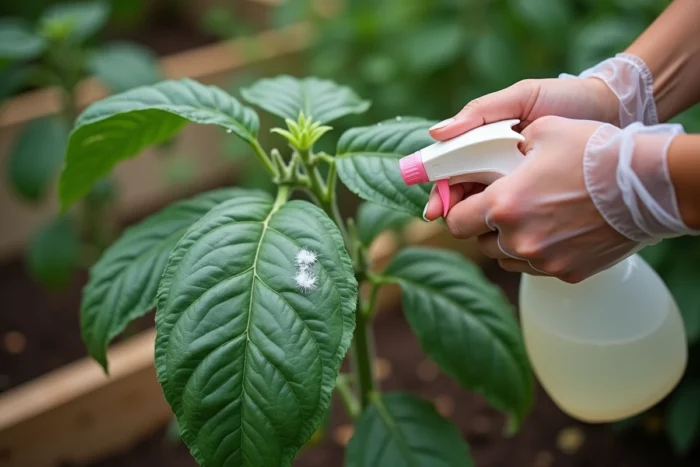
The confusion between prevention and curative treatment explains most of the failures reported by gardeners. Baking soda works preventively and at the very beginning of an infection, when the spores have not yet penetrated the leaf cells.
Applied to healthy foliage before a risky period (high humidity, cool nights), it forms a temporary alkaline barrier. On leaves where powdery mildew is already well established, with a thick white coating, spraying does not eliminate the fungus rooted in the epidermal cells.
Why uniform leaf coverage matters as much as dosage
A rarely discussed angle concerns the quality of the application. Baking soda only acts where it is deposited. Uneven spraying leaves unprotected areas, which become entry points for spores.
- Spray the top and bottom of the leaves, as many fungi first colonize the underside
- Renew the application after each rain, since runoff water dissolves the alkaline deposit
- Treat early in the morning or late in the day to prevent the solution from drying too quickly under direct sunlight
Without this regularity, even a correct dosage does not provide lasting protection for the foliage.
Baking soda leaf burn: causes and sensitive leaves
Reports from gardeners indicate burned leaves after a baking soda spray. This phenomenon is real, and it is due to two factors that often combine.
The first is overdosing. Beyond a teaspoon per liter of water, the risk of burning significantly increases. The sodium concentration becomes too high for the epidermal cells, causing localized dehydration that results in brown spots or drying of the leaf edges.
The second factor is the sensitivity specific to each plant. Young leaves, still thin and poorly cutinized, do not tolerate concentrated alkaline solutions well. Tomatoes, zucchinis, and squashes generally tolerate baking soda at low doses, but some ornamental plants with tender foliage react from the first application.
Test before treating the entire plant
Before spraying the entire foliage, apply the solution to a few leaves and observe for two days. If no discoloration or drying appears, the treatment can be extended. This simple precaution prevents turning a preventive care into widespread damage.
Limitations of baking soda against leaf diseases
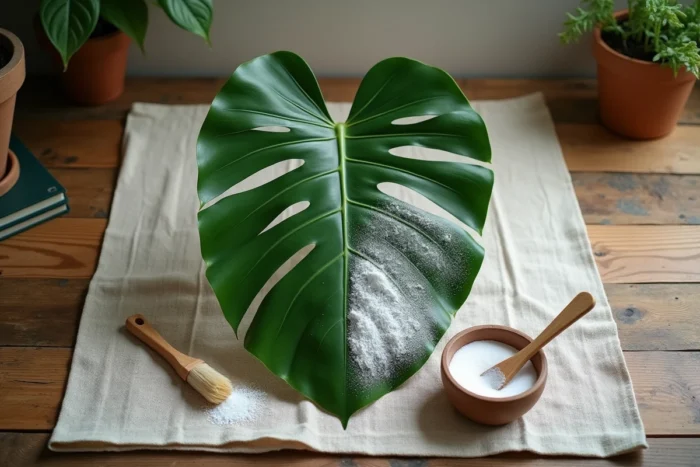
Powdery mildew remains the main target of baking soda in the garden. However, reducing leaf diseases to this single fungus would be misleading. Downy mildew, rust, black spot on roses: each pathogen has its own biology, and baking soda is not a universal solution against all leaf diseases.
Against downy mildew, for example, the fungus progresses rapidly within the internal tissues of the leaf. A pH barrier on the surface has little effect once the infection is established. Bordeaux mixture (copper-based) or horsetail decoction are more suitable alternatives in this case, although each has its own limitations of use.
- Powdery mildew: baking soda offers adequate preventive protection as long as applications are renewed
- Downy mildew: very limited effectiveness, the pathogen penetrates too quickly into the tissues
- Black spot on roses: some gardeners report a preventive effect, but the data remains anecdotal
- Rust: baking soda shows no documented effect on this type of fungus
Considering baking soda as a tool among others, and not as a miracle treatment, allows for adjusting the strategy according to the problem observed on the foliage.
Baking soda modifies the surface pH of leaves and slows the germination of certain spores. Its effectiveness depends more on the rigor of application than on the product itself. Misapplied or applied to fragile tissues, it causes exactly the damage one sought to avoid.
Respecting the concentration of one teaspoon per liter, treating before symptoms appear, and renewing after each rain: baking soda works within this precise framework, not outside of it.