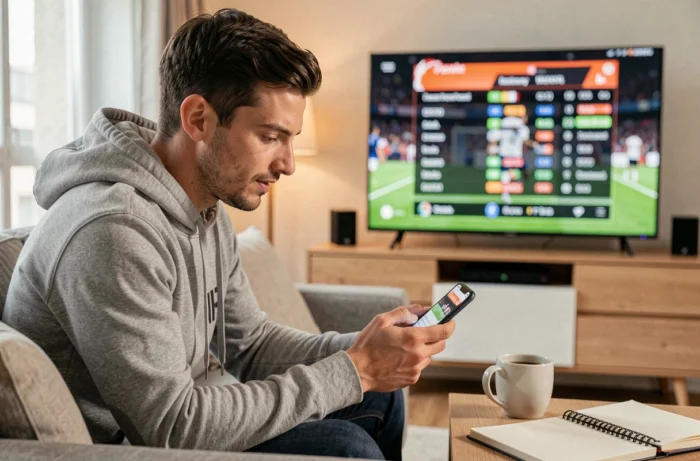
Following a Ligue 1 match on one platform, switching to another for the Champions League, and then opening a third app for weekend rugby: the dispersion of sports rights among broadcasters turns real-time tracking into an obstacle course. Sports results are plentiful online, but gathering them without juggling five tabs and three subscriptions remains a real practical issue.
Fragmentation of TV and streaming rights: what it changes in daily life
We see it every season: broadcasting agreements reshuffle the deck. A club may have its league matches on one service, its European cups on another, and its friendly matches on a third. The NBA recently distributed its broadcasting windows among Disney, NBCUniversal, and Amazon Prime Video. European football follows the same logic, with rights split country by country and competition by competition.
For a supporter following a team like PSG or Lens across multiple fronts (league, cup, Europe), this potentially means multiple overlapping subscriptions. The cost rises, and clarity decreases.
Platforms rarely aggregate competing competitions. A broadcaster holding Ligue 1 will not display Premier League scores in real-time. As a result, one ends up checking sports news on Sport At Once or similar portals capable of centralizing results and trends without being tied to a single rights catalog.
Live score apps: beyond just a simple scoreboard
Live score applications have evolved significantly. They no longer just display an updated score every minute. Recent apps combine alerts, statistics, and video in almost real-time, with data such as ball possession or win probability updated within seconds.
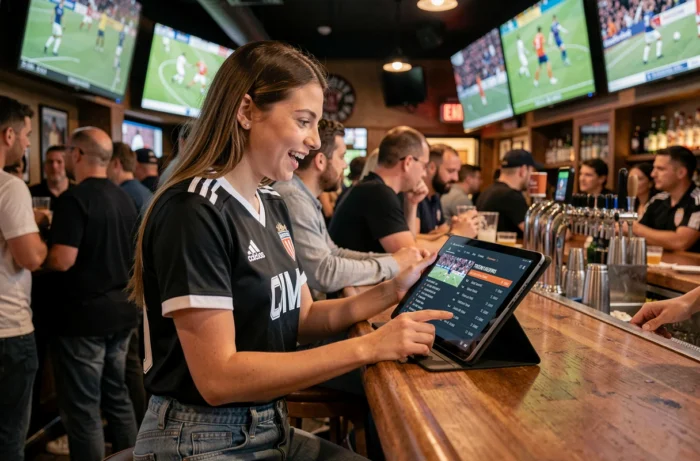
This layer of enriched data changes the way one follows a match without watching it. It provides an analytical reading of the game, not just a raw number. Sportradar, for example, offers live video streams coupled with live odds and data visualization, clearly demonstrating the convergence between sports tracking and real-time analysis.
The downside: the proliferation of notifications. Each app pushes its alerts, and without careful settings, the phone vibrates continuously on a Champions League night. Disabling generic notifications and keeping only team alerts remains the most effective setting to avoid overload.
What a good sports tracking app should offer
- Customizable alerts by team, competition, and type of event (goal, red card, halftime), not just a generic global feed
- Real multisport coverage: football, rugby, tennis, and if possible, less mainstream sports like handball or volleyball, whose visibility is increasing thanks to digital agreements
- Access to match statistics (possession, shots on target, expected goals) directly in the results feed, without having to open a separate page
- An offline mode or delayed summary to catch up on scores without spoilers when watching a replay
Women’s sports and less exposed disciplines: a blind spot that is shrinking
Women’s competitions and so-called niche sports are increasingly benefiting from digital broadcasting agreements. Where traditional television reserved its slots for men’s football and the Six Nations rugby tournament, digital platforms are opening windows for women’s football, handball, or emerging sports.
This movement is also changing the landscape of results applications. An app that only covers the five major men’s football leagues misses out on a growing part of the demand. Supporters following the French women’s team or D1 Arkema expect the same level of real-time coverage.

Feedback varies on this point depending on the apps: some already display live scores for these competitions, while others only provide delayed results. Checking the actual coverage before choosing a tracking tool avoids disappointments during a tournament.
Centralizing sports tracking without saturating screens
Multiplying sources of information does not guarantee better awareness. On the contrary, too many apps and subscriptions create noise that drown out useful information. The most effective approach is to reduce the number of entry points.
Specifically, one can structure their tracking around two complementary tools:
- A multisport results aggregator with targeted alerts, covering real-time scores and basic statistics for all competitions followed
- One video subscription for the matches one truly wants to watch in full, chosen based on the priority competition (domestic league or European cup, depending on preferences)
- A sports analysis feed (specialized press, podcast, newsletter) for tactical context and overarching trends, consulted in delayed mode rather than in real-time
This combination covers immediate results, video spectacle, and analysis, without stacking four or five redundant services. Sorting is done in advance, not in reaction to notifications.
Setting alerts by competition rather than by sport
A often-overlooked setting: filtering alerts not by sport (football, tennis, rugby) but by specific competition. Receiving a notification for every Ligue 2 match when following only RC Lens makes no sense. Granularity by team or competition phase (quarter-finals and beyond, for example) significantly reduces the volume of alerts.
Real-time sports data has never been more accessible, but the real challenge has shifted: it is no longer technical, it is organizational. Choosing fewer, better-configured sources provides clearer tracking than having a dozen apps open simultaneously.