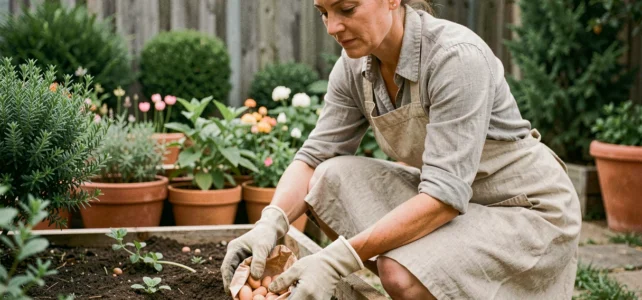
Expanded clay balls accumulate in pots, planters, and growing trays over the seasons. When the time comes to empty a container or change the substrate, the question of what to do with these balls arises. As a mineral material fired at high temperatures, expanded clay does not decompose, does not compost, and does not fit into any obvious category of domestic selective sorting.
Clay Balls and Waste Classification: A Local Regulatory Ambiguity
Once fired, clay balls become an inert material. They do not release toxic substances into the soil or water. From a regulatory standpoint, they are similar to inert or mineral waste, just like rubble or shards of terracotta.
The difficulty arises from the fact that sorting guidelines vary from one municipality to another. Some recycling centers accept clay balls in the “inert waste” or “rubble” bin, while others direct them to green waste if they are mixed with potting soil and roots. Still, others refuse them due to a lack of clear guidelines.
Before loading a bag into the trunk, it is essential to check with the local recycling center. A quick call or a visit to the community’s website is enough to find out the appropriate bin. When looking to dispose of clay balls properly, this preliminary step avoids unnecessary trips.
The strengthening of waste sorting obligations for construction waste in France, along with the rise of REP (extended producer responsibility) systems and eco-organisms dedicated to inert waste, is pushing recycling centers to better structure the acceptance of these flows. Although produced in small volumes by individuals, clay balls fall into this logic.
Reusing Clay Balls: The Reflex Before the Trash
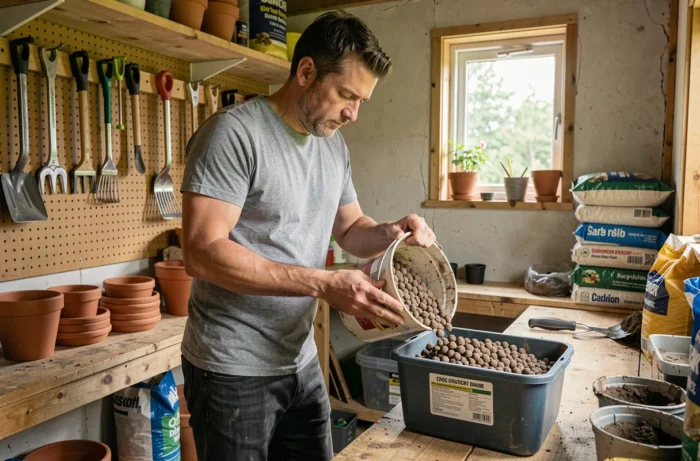
Throwing away clay balls should be a last resort. This material is virtually indestructible under normal gardening conditions. Its porous structure does not degrade upon contact with water, roots, or potting soil.
Cleaning and Recommissioning for Drainage
Clay balls recovered during repotting can be cleaned with clear water in a sieve or a wide-mesh colander. The goal is to remove soil, dead roots, and any potential limescale deposits. Soaking them for a few hours in vinegar water helps dissolve accumulated limescale.
Once dry, they regain their drainage capacity and can be reused at the bottom of a new pot. This operation can be repeated many times without any notable loss of performance.
Other Uses in the Garden and at Home
Clean clay balls find a second life in several concrete situations:
- As mineral mulch on the surface of indoor pots, to limit water evaporation and reduce the frequency of plant watering
- As a drainage layer under a raised vegetable bed, replacing gravel to lighten the structure
- At the bottom of a balcony planter, where their lightness is an advantage over stones or pot shards
- Mixed with the substrate of cacti and succulents, to improve soil aeration and prevent water stagnation at the roots
Reusing rather than throwing away reduces waste volume and avoids calling on a collection system for a material that retains all its properties.
Soiled Clay Balls: The Case of Organic and Chemical Residues
The situation becomes more complicated when the balls are mixed with organic matter that is difficult to separate, or when they have been used with concentrated chemical fertilizers or plant protection treatments.
Clay balls simply mixed with potting soil and roots do not pose an environmental problem. The mixture can be deposited at a recycling center, ideally after a quick sorting. Separating the soil and plant debris (which go into green waste) from the balls (which go into inert waste) facilitates their treatment.
On the other hand, balls that have soaked in nutrient solutions heavily dosed in hydroponics deserve thorough rinsing before reuse or disposal. Residues of concentrated mineral salts can alter the soil pH if the balls are dispersed directly into a garden without precautions.
Field reports vary on this point: some gardeners reuse balls from hydroponic systems without issue after a simple rinse, while others observe root burns on sensitive plants. A prolonged soak in several successive baths of water remains the most reasonable precaution.
Throwing Clay Balls in the Regular Trash: What It Implies
Putting clay balls in the household waste bin is not prohibited by law, but it raises a common-sense issue. Household waste ends up being incinerated or landfilled, both unsuitable processes for an inert mineral material that could be valorized otherwise.
In incineration, clay balls do not burn. They weigh down the ash without providing any calorific value. In a landfill, they occupy a volume that will never decompose. In both cases, the environmental impact is poor for a material that had no reason to leave the gardening circuit.
The volume constraint also plays a role: a few handfuls of balls go unnoticed, but emptying a large growing tray can represent several dozen liters. At this point, the recycling center becomes the only coherent option.
Giving Away or Exchanging Used Clay Balls
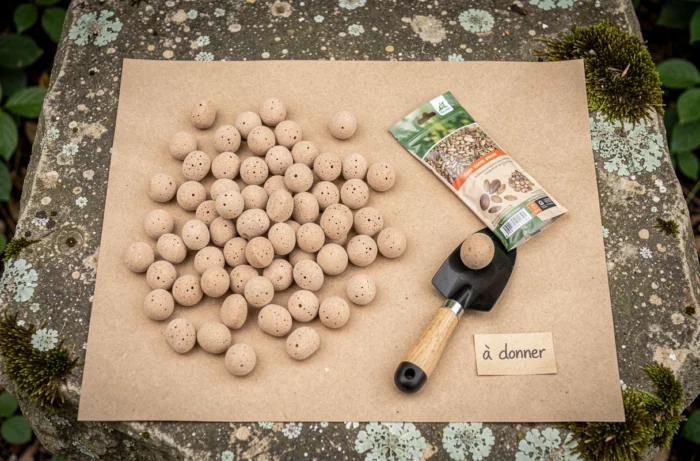
Amateur gardening groups on social media and platforms for peer-to-peer donations represent an often-overlooked channel. Clean clay balls, even if already used, interest people starting pot or hydroponic plantings.
Donating avoids both the purchase of new balls and the production of waste. Posting an ad with a photo and an indication of the volume is usually enough to find a taker within a few days, especially in spring when the demand for gardening materials increases.
Community gardens and gardening associations also frequently accept this type of material. A bag of clay balls always finds a use there, whether for drainage in communal bins or repotting garden plants.
The most logical course of action remains simple: clean, reuse, donate, and only as a last resort, deposit at the recycling center in the appropriate bin. Clay balls have no place in a regular trash bin or scattered in nature without prior consideration.