
Doliprane and Aerius are among the most commonly found medications in French medicine cabinets. The former, based on paracetamol, targets pain and fever. The latter, containing desloratadine, alleviates symptoms of allergic rhinitis and urticaria.
When an allergic episode is accompanied by headaches or fever, the temptation to take both at the same time is common. The question of their compatibility deserves careful examination, beyond the simple “yes, it’s possible.”
Hepatic metabolism: the real point of caution for this combination
Both paracetamol and desloratadine are processed by the liver for transformation and elimination. Paracetamol is primarily metabolized by liver enzymes, and it is this metabolism that can generate a toxic metabolite in the case of overdose. Desloratadine, for its part, also passes through the liver before being eliminated.
No direct pharmacological interaction between the two molecules has been identified in official databases (public drug database). However, the liver is simultaneously engaged by both substances. For a healthy person, this dual engagement does not pose measurable difficulties at usual dosages.
The problem arises when the liver is already compromised. Hepatic insufficiency, regular alcohol consumption, and the use of other hepatotoxic medications: these factors change the situation. The question of whether Doliprane and Aerius can be taken together thus depends less on the interaction between the two molecules than on the state of the liver at the time of ingestion.

Pregnancy and breastfeeding: little-known limits on desloratadine
Public articles often state that the combination is “generally safe,” without distinguishing at-risk populations. The available data on desloratadine in the context of pregnancy provides a nuance that is rarely mentioned.
More than 1,000 documented pregnancies have not shown any malformative effects related to desloratadine. The product characteristics summaries (RCP) confirm this. Despite this, these same official documents specify that, as a precaution, the use of desloratadine is not recommended during pregnancy due to insufficient data to conclude on long-term safety.
In other words, the limitation on the combination comes from Aerius, not Doliprane, in this specific context. Paracetamol remains the reference analgesic during pregnancy. The decision to add an antihistamine should be individualized with a doctor or pharmacist.
Transfer into breast milk
Desloratadine is excreted in breast milk. This transfer has been documented in the official drug data. Paracetamol also passes into milk but at concentrations considered compatible with breastfeeding at usual doses.
Taking both medications while breastfeeding is not formally contraindicated, but medical advice is recommended before taking Aerius in breastfeeding women.
Dosage and paracetamol accumulation: the most common risk in practice
The most concrete danger related to this combination does not come from Aerius. It comes from paracetamol itself, and more specifically from unintentional accumulation. Paracetamol is included in the composition of dozens of products: cold medications, combined analgesics, sachets for flu-like symptoms.
A patient taking Doliprane for fever and simultaneously a cold medication that already contains paracetamol may exceed the maximum dose unknowingly. This situation represents the primary cause of accidental paracetamol overdose.
- Systematically check the composition of each medication taken simultaneously, including over-the-counter cold or flu products
- Respect a minimum interval between two doses of paracetamol (the leaflet of each product specifies this interval)
- Avoid any alcohol consumption while taking paracetamol, as alcohol increases the hepatotoxicity of paracetamol
- Inform the pharmacist or doctor of all current medications, including those without a prescription
Aerius, on the other hand, is not “hidden” in other products in the same way. The risk of accumulation is specific to paracetamol.
Warning signs after simultaneous intake of Doliprane and Aerius
In most cases, the joint intake produces no notable adverse effects. Desloratadine is a second-generation antihistamine, which means it causes less drowsiness than older antihistamines. Paracetamol, at recommended doses, is well tolerated.
However, certain signs should raise alarms:
- Persistent nausea or pain in the liver area (under the right ribs), which may indicate liver damage
- Yellowing of the skin or eyes (jaundice), a sign of advanced liver distress
- Unusual drowsiness or palpitations, which may indicate a reaction to desloratadine or an interaction with another medication taken concurrently
In case of suspected paracetamol overdose, contact with a poison control center or emergency services should be immediate. The timing of intervention directly affects the effectiveness of the antidote treatment.
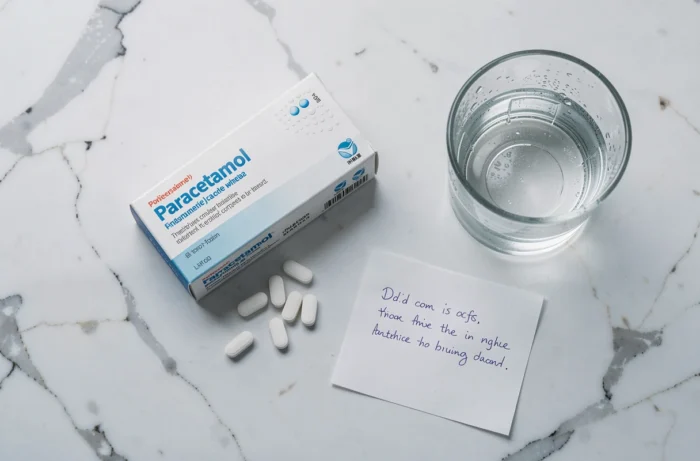
Aerius without a prescription: a game-changing self-medication
Desloratadine is available without a prescription in certain forms. This accessibility facilitates self-medication, including for people who already take paracetamol regularly for other reasons (chronic pain, recurrent febrile states).
The fact that no direct interaction exists between the two molecules does not exempt one from a minimum of caution. The absence of interaction does not mean the absence of individual risk. A patient undergoing treatment for liver insufficiency, a polymedicated elderly person, or a young child is not in the same situation as a healthy adult occasionally taking both medications.
The pharmacist remains the first point of contact to validate this combination on a case-by-case basis, taking into account the entire ongoing treatment and overall health status. This step, often perceived as unnecessary for “common” medications, is precisely what prevents accidents related to self-medication.