
Since September 2026, European regulations prohibit vague environmental claims on consumer products. Terms like “eco-friendly,” “green,” or “carbon neutral” must now be substantiated according to recognized standards. This regulatory change fundamentally alters how a consumer can assess the credibility of a so-called responsible product.
Adopting a more responsible economy in daily life is no longer limited to sorting waste or reducing water consumption. The European legal framework now provides measurable criteria to distinguish a genuine commitment from mere marketing rhetoric.
European Regulation on Green Claims: What Changes for Responsible Purchasing
Before this regulation, a manufacturer could label a product as “nature-friendly” or “biodegradable” without providing any technical proof. These generic environmental claims are now prohibited unless the professional demonstrates recognized environmental performance according to standards such as the European Ecolabel or ISO 14040 and 14044.
Claims like “carbon neutral” or “climate neutral,” based solely on carbon offsetting, can no longer be used without demonstrating performance across the entire product lifecycle. For consumers, this means that labels are becoming a more reliable verification tool than before.
In practical terms, the benchmarks to look for on packaging or product sheets are now more standardized. Resources like economielogique.com help to better understand the economic mechanisms behind these regulatory changes.
| Claim | Before Regulation | Since September 2026 |
|---|---|---|
| “Eco-friendly” / “Green” | Allowed without proof | Prohibited without recognized certification (Ecolabel, ISO) |
| “Carbon Neutral” | Based solely on offsetting | Requires a complete lifecycle analysis |
| “Biodegradable” | No demonstration conditions | Must be proven according to specific standards |
| “Zero Waste” / “Zero Impact” | Free use in marketing | Prohibited if not rigorously demonstrated |
This table summarizes the gap between the old self-declaration regime and the new binding framework. Consumers finally have a regulatory filter for their purchasing choices.
Household Carbon Footprint: Key Spending Areas to Prioritize
Competitors often list ten eco-friendly actions without hierarchy. However, not all consumption areas carry the same weight in a household’s carbon footprint. Prioritizing requires knowing where emissions are concentrated.
Three categories dominate a household’s emissions:
- Individual travel represents the largest share. The majority of transport-related emissions come from personal vehicle use, according to ADEME data. Switching to cycling for short trips or carpooling for commuting produces a measurable effect.
- Meat consumption weighs significantly more than other food categories. Reducing the frequency of meat consumption (even partially) has a greater impact than switching to organic for the entire grocery basket.
- Heating and energy consumption in housing constitute the third lever. Insulation, thermostat adjustments, and choosing energy-efficient appliances change both the bill and the footprint simultaneously.
Addressing these three areas yields more results than multiplying small actions in marginal areas. It’s a matter of allocating effort.
Circular Economy and Second-Hand: Real Impact on Responsible Consumption
The circular economy goes beyond simple recycling. It includes repair, resale, reuse, and rental. The AGEC law (Anti-Waste for a Circular Economy) imposes increasing obligations on manufacturers regarding the durability and reparability of products.
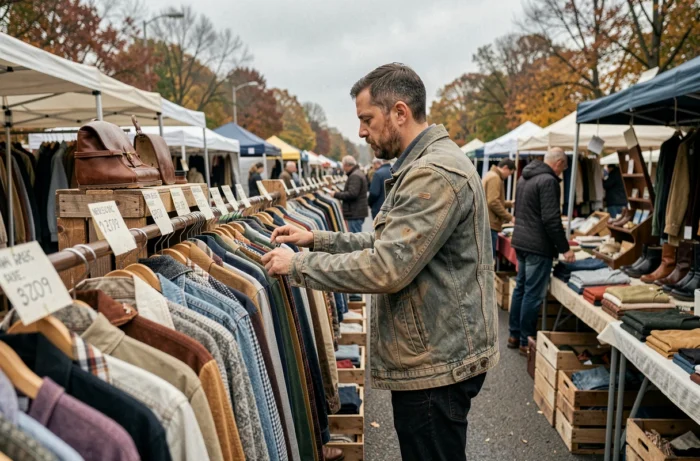
Buying second-hand reduces the demand for new production, which decreases emissions related to manufacturing and transport. For appliances, electronics, or furniture, the second-hand market offers functional alternatives at lower costs.
Labels and Indices to Check Before a Purchase
The reparability index, mandatory in France for several product categories, gives a score out of 10. A high score indicates that it will be possible to repair the device rather than replace it. Prioritizing a reparability index above 7 extends the product’s lifespan.
Labels like the European Ecolabel or the NF Environment label remain reliable benchmarks, as they are based on specifications verified by independent organizations. In contrast, brands’ self-declarations (“our green commitment,” “responsible collection”) do not undergo any external scrutiny.

Food Waste and Energy: Two Concrete Levers for Waste Reduction
Food waste occurs at all stages of the chain, but at the household level, the main causes are over-purchasing and poor management of expiration dates. Planning meals for the week before shopping cuts food waste.
On the energy side, some actions yield disproportionate returns relative to their simplicity. Lowering the heating by one degree significantly reduces consumption. Unplugging devices on standby and using power strips with switches addresses phantom consumption, which remains active continuously.
Cleaning Products and Cosmetics: Reducing Substances and Packaging
Making household products from white vinegar, baking soda, and black soap eliminates a large portion of plastic packaging and chemical substances. ADEME recommends limiting the number of different products used in a household, as multiplying references increases waste without improving cleaning efficiency.
For cosmetics, solid formats (shampoo, soap, toothpaste) eliminate plastic bottles. Their usage duration is generally longer than that of liquid equivalents.
The European regulation on green claims makes these trade-offs clearer. A product that claims “zero waste” without proof will be penalized. A product certified by an independent label offers verifiable assurance. Reading labels with the right criteria becomes the first step towards a responsible economy in daily life.