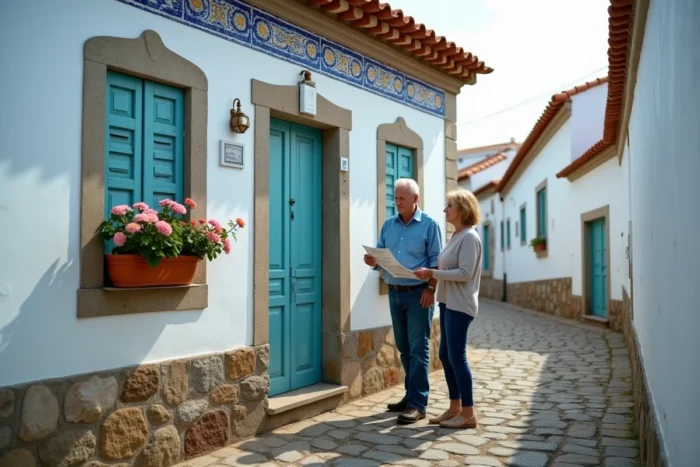
The Portuguese real estate market attracts more and more foreign buyers each year, and small fisher houses are capturing an increasing share of this demand. However, finding an affordable property on the Portuguese coast requires going beyond traditional listing portals and understanding what separates a viable project from a losing investment.
Tourist rental license: the regulatory filter to check before any visit
Before falling under the charm of a lime-washed facade, the first step is to inquire with the câmara municipal (town hall) to which the property belongs. The reason lies in one question: can the housing obtain a tourist rental license (alojamento local)?
This eligibility conditions the profitability of the project for anyone considering renting the property for part of the year. The rules vary from one municipality to another, and some coastal municipalities have tightened their criteria in recent years. A property that cannot be legally rented to tourists loses a significant part of its utility value for a non-resident buyer.
If your goal is strictly a second home, the question arises differently. However, for a mixed purchase (personal use and seasonal rental), the absence of a license can render the project unprofitable once renovation costs are factored in. Checking this point with the town hall before even signing a viewing contract can save months of unnecessary steps.
For those looking for a small fisher house for sale in Portugal, this regulatory check is the first effective filter between real opportunity and administrative deadlock.

Silver Coast and Alentejo coast: where to find affordable fisher houses
The Algarve and the outskirts of Lisbon attract media attention, but prices there have reached levels that exclude most average budgets. Available data on the Portuguese real estate market shows that the Alentejo coast and the Silver Coast remain significantly more accessible for this type of property.
The Silver Coast, roughly stretching between Nazaré and the Peniche region, still has fishing villages where the supply has not yet been absorbed by international tourist demand. The inland municipalities close to the coast also present opportunities, with traditional houses to renovate that remain low-priced compared to the south of the country.
The Alentejo coast, between Comporta and the Algarve border, offers a different profile. The villages there are more isolated, the tourist density is lower, and the available properties are often more rustic. For a buyer willing to invest in renovation, this area offers a price-to-quality-of-life ratio that is hard to match elsewhere on the Portuguese coast.
What online portals do not show
The most interesting small fisher houses do not always appear on major listing sites. Agencies located in a specific port, local notaries, and ground contacts regularly capture properties before they are listed online. This informal circuit is particularly active for modest properties, whose owners do not systematically go through digital platforms.
Visiting the area, frequenting the village cafes, and talking with local real estate agents remains the most reliable lever to access these properties. Field feedback varies on the effectiveness of remote-based property hunters, who sometimes work in areas that are too broad to spot these micro-opportunities.
Technical diagnosis before the contrato-promessa: avoiding impulse purchases
An old fisher house by the sea accumulates technical constraints that the enthusiasm of a first visit tends to mask. Walls exposed to sea spray, a framework weakened by saline humidity, lack of insulation, outdated electrical installations: the list of renovation items can turn an affordable purchase into a financial pitfall.
Engaging a local engineer before signing the contrato-promessa (promise to purchase contract) is the most reliable precaution to avoid this scenario. This diagnosis is not limited to a visual inspection. It should cover:
- The structural condition of load-bearing walls and the roof, with particular attention to corrosion due to maritime proximity
- The compliance of networks (water, electricity, sanitation) with current standards, as some old houses still operate with installations not connected to the municipal network
- The feasibility of a renovation within the framework of the local urban planning plan, which may impose constraints on materials, volumes, or facade openings
The cost of this diagnosis represents a fraction of the purchase price, but it allows for accurate estimation of actual renovation costs and negotiating the price accordingly. Without this step, the renovation budget can exceed the acquisition price of the property.

Second home, seasonal rental, or renovation-resale: three different projects
The most common mistake is to buy without having decided between these three uses. Each involves distinct selection criteria, budgets, and administrative constraints.
For a second home, location is paramount: proximity to an airport served by direct flights, access to shops, quality of the neighborhood off-season. A house in a village that empties between October and April may suit some, but not everyone.
For tourist rental, the alojamento local license is the prerequisite (see above), and profitability depends on the realistic occupancy rate in the area. Highly touristic municipalities offer better occupancy rates, but purchase prices are proportionally higher there.
For a renovation-resale project, the margin entirely depends on the difference between the total cost (purchase plus renovation plus fees) and the estimated resale price. This type of project requires a deep knowledge of the local market and available craftsmen, in a context where construction costs in Portugal have significantly increased in recent years.
Confusing these three logics leads to shaky compromises: buying too expensively to rent, too far to enjoy, or too dilapidated to resell. Defining the project before searching for the property, and not the other way around, remains the safest method to ensure that the purchase of a small fisher house in Portugal aligns with actual expectations.