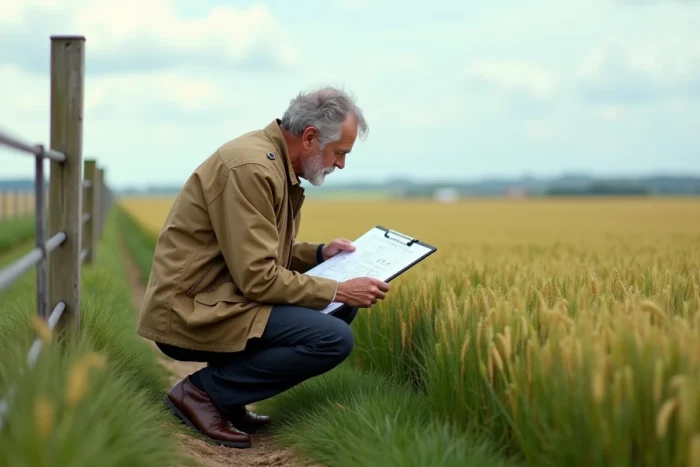
Notarial acts, cadastral surveys, and land announcements still heavily use hectares, ares, and centiares. These units, inherited from the republican metric system, pose a concrete problem: most real estate portals filter results in square meters, and individuals think in m² when comparing plots. Mastering the conversion from one unit to another avoids costly mistakes, especially during a transaction.
Reading a cadastral survey: the trap that conversion tables do not show
Equivalence tables circulate everywhere. They remind us that 1 hectare equals 10,000 m², that one are corresponds to 100 m², and that one centiare equals 1 m². These ratios are simple, but they are not enough to avoid the most common mistake on the ground.
A cadastral survey or notarial act may indicate a surface in the form “3 a 45 ca”. Many readers interpret this figure as 3,045 m². The actual value is 345 m², which is almost ten times less.
The notation in ares and centiares works like a two-column system: ares occupy the hundreds position, while centiares occupy the units position. Confusing these columns is like reading “3 hours 45 minutes” as “3,045 minutes”.
To avoid this misunderstanding, simply break down the reading: 3 ares give 300 m², to which we add 45 centiares, or 45 m². The total is indeed 345 m². The practical difficulty of the conversion of hectares, ares, and centiares to m² lies in this positional reading, not in the multiplication itself.

Conversion method from hectare, are, centiare to square meters
The principle is based on a constant factor between each unit: a ratio of 100. Moving from one hectare to one are means multiplying by 100. Moving from one are to one centiare also means multiplying by 100. From hectare to square meter, the total factor is therefore 10,000.
In practice, the conversion boils down to three operations:
- Multiply the number of hectares by 10,000 to get m²
- Multiply the number of ares by 100 to get m²
- Directly report the centiares, since 1 centiare equals exactly 1 m²
When a surface combines the three units (for example, 2 ha 7 a 30 ca), we add the partial results: 20,000 + 700 + 30 = 20,730 m². The method never changes, regardless of the size of the plot.
The column shift as a mental shortcut
Each unit occupies two digits in a conversion table. The hectare is two columns to the left of the are, which is itself two columns to the left of the centiare (or m²). To convert, simply fill the empty boxes with zeros.
Example: 5 ha is written as 5 | 00 | 00 in the table, which equals 50,000 m². Similarly, 12 a is written as 12 | 00, which equals 1,200 m². This visual technique works without a calculator and reduces the risk of forgetting a zero.
Why real estate portals impose the square meter
Real estate professionals are strongly encouraged to display the area of plots in square meters in their listings, even when the deed or the cadastral document uses ares or hectares. The reason is technical: the search filters of the portals work in m². A plot displayed in ares will not appear in the results if the buyer filters by area in square meters.
This constraint makes the square meter the pivot unit of the online land market. Ares and hectares remain present in legal documents, but they are gradually disappearing from interfaces intended for the general public. Therefore, conversion is not an academic exercise: it is a mandatory step to publish or interpret a listing.

Boundary setting and reliability of the area before conversion
Converting an area is only valuable if the starting measurement is reliable. The areas recorded in the cadastre are fiscal data, not guaranteed geometric measurements. They may diverge from the physical reality of the plot, sometimes significantly.
Boundary setting, carried out by a surveyor, establishes the exact limits of a plot and produces a legally enforceable area. Without boundary setting, the conversion to m² is based on a potentially inaccurate figure. During a sale, the difference between the cadastral area and the bounded area can affect the price or lead to a dispute.
Some practical guidelines to ensure the reliability of the area:
- Check if a boundary setting report already exists with the surveyor or notary
- Compare the cadastral area with that mentioned in the title deed
- Request a contradictory boundary setting before any transaction if the figures diverge
The conversion to square meters then becomes a reliable calculation, applied to a verified data point and not to an administrative estimate.
Common errors when converting land areas
Beyond the confusion “3 a 45 ca = 3,045 m²” already mentioned, other errors occur regularly. Forgetting a zero when converting from hectares to m² turns a plot of 2 hectares (20,000 m²) into 2,000 m², which is the size of a large garden instead of a field. Conversely, adding an extra zero multiplies the area by ten.
Another source of confusion comes from mixing agricultural units and units of the international system. The are does not belong to the SI but remains legally used in French land transactions. The square kilometer (1,000,000 m²) is used for communal or forest areas, not for individual plots. Using km² instead of hectare in a land calculation introduces a factor of 100 error.
The best protection remains cross-checking: convert in one direction, then reconvert in the other to find the initial value. If the result does not match, a factor error has slipped into the calculation.