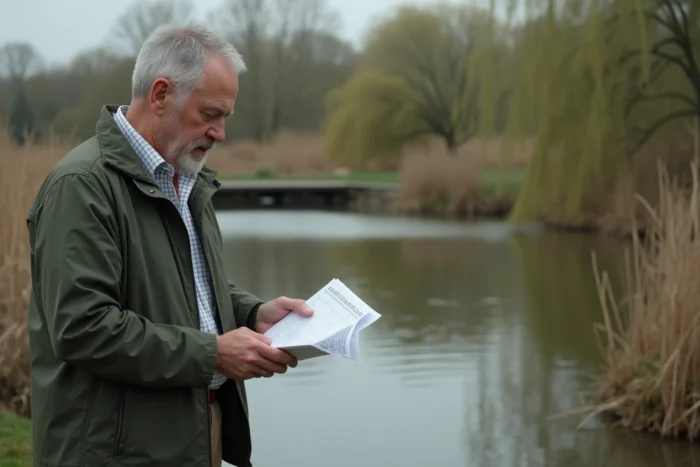
Buying a pond in France involves checking much more than the surface area of the water body and its price per square meter. Between the legal status of the property, compliance with water law, and the preemption rights of the SAFER, the formalities determine the success of a transaction. This article reviews the contractual checkpoints, cost variations based on configurations, and the administrative pitfalls that the notarial deed must cover.
Contractual Clauses to Require in the Sale Agreement of a Pond
Most pond buying guides detail environmental regulations in general, without specifying what the buyer must require in writing in the agreement. Yet, this is where the legal security of the operation is at stake.
The seller must certify, through an express clause, the compliance of the pond under water law. This certification is accompanied by the prefectural orders of authorization or declaration receipts, along with their date and number. Without these documents, the buyer inherits a risk of formal notice from the water police, which could lead to the obligation to restore the site.
Before signing, it is useful to fully understand the formalities for the sale of a pond to anticipate the appropriate suspensive conditions for this type of property.
A clause must also specify the allocation of works to bring the standards up to date that have already been prescribed or are foreseeable on the hydraulic structures (sluice, spillway, dam). Two options: either the seller carries out these works before the sale, or a discount on the price includes their estimated cost by an expert appointed by the buyer.
Three suspensive conditions deserve to be systematically included:
- The compliance of the hydraulic structures, verified by an independent expert chosen by the buyer, and not by the seller or the real estate agent.
- The purging of the SAFER’s preemption right, which can be exercised on any property intended for agricultural use, including a pond intended for fish farming.
- The absence of ongoing administrative procedures or environmental classification (Natura 2000, ZNIEFF) that would restrict the intended use of the water body.

Notary Fees and Actual Costs When Buying a Pond
The purchase of a pond falls under the tax regime for rural properties, not under traditional built real estate. This distinction has a direct impact on notary fees and the total cost of the acquisition.
| Cost Item | Pond (unbuilt rural property) | Classic Buildable Land |
|---|---|---|
| Transfer Taxes | Approximately 5.80% of the price | Approximately 5.80% of the price |
| Notary Fees | Identical declining scale | Identical declining scale |
| Specific Fees | Hydraulic structure diagnosis, water law verification, SAFER purging | Soil study, urban planning certificate |
| Risk of Post-Purchase Additional Costs | Works to bring the structures up to standard (sluice, dam, spillway) | Servicing, network connections |
The transfer taxes are comparable. However, the additional fees differ significantly: a pond requires technical checks that do not exist for buildable land. The diagnosis of hydraulic structures and the search for administrative compliance represent a budget to be anticipated from the negotiation phase.
Discount Related to Non-Compliance of Structures
A pond whose structures are not compliant with water regulations suffers a significant discount. The cost of bringing a dam or drainage system up to standard can represent a notable portion of the purchase price, especially for small water bodies. Negotiating the price by including these works is the only guarantee against unforeseen additional costs.
Closed Water or Free Water: The Criterion That Changes Fishing Ownership
The status of the water body, closed water or free water, determines who has the right to fish there and under what rules. This distinction is often misunderstood, and it does not always appear clearly in sales listings.
A pond classified as closed water is a water body where fish cannot move freely to a watercourse. The owner then holds an exclusive fishing right, without the obligation of a fishing license or adherence to regulated opening periods. They manage the fish population as they see fit.
In contrast, a pond classified as free water is connected to a hydrographic network where fish can move. Fishing regulations apply fully: fishing license required, adherence to minimum catch sizes, and opening periods set by prefectural order. The owner retains the fishing right attached to the land, but its exercise is regulated.
The sale agreement must explicitly mention this status. In case of doubt, the departmental directorate of territories (DDT) can confirm the qualification of the water body. A reclassification from closed water to free water can occur if works or modifications to the land allow fish to move to an adjacent watercourse.
Pond Drainage: A Regulated Obligation, Not a Free Maintenance Gesture
Draining a pond is not a decision made on a whim. The operation is subject to declaration or prior authorization from the prefecture, depending on the surface area of the water body and the volume of water discharged into the natural environment.
The drainage must comply with specific periods, usually set by prefectural order, to avoid disrupting the reproduction of aquatic species downstream. The discharge of drainage water into a watercourse is monitored: temperature, turbidity, and organic matter load are among the parameters monitored.
- Check if the pond has a drainage schedule already prescribed by the administration.
- Ensure that the drainage system (sluice or valve) is functional and compliant with current standards.
- Anticipate the cost of drainage, which includes labor, management of the recovered fish, and monitoring of the quality of the discharged water.
A buyer who discovers after signing that the drainage system is out of order bears the costs of restoring it alone, unless otherwise stated in the deed. This is an expense that the prior technical visit should cover.
The sale of a pond involves verifications that neither the displayed price nor the surface area of the water body can anticipate. The legal status of the property, the compliance of the structures, and the clauses of the agreement form a triptych that each buyer must master before signing. An incomplete sales deed on these points exposes one to additional costs and lasting administrative constraints.