
Measuring the technological trends of 2024 involves comparing very different adoption cycles. Some technologies, such as generative artificial intelligence, have moved beyond experimentation to become part of companies’ recurring budgets. Others, like digital twins or algorithmic regulation, are progressing more quietly but are profoundly changing management systems and decision-making models in hospitality, retail, and industry.
European AI Act: Regulatory Compliance as a Competitive Advantage
Articles on technological trends for 2024 mention artificial intelligence, but rarely the legal framework that structures it. Regulation (EU) 2024/1689, known as the AI Act, was adopted on June 13, 2024, published in the Official Journal on July 12, 2024, and came into effect on August 1, 2024.
This regulation classifies AI systems according to four levels of risk: unacceptable, high, limited, and minimal. Practices deemed unacceptable (generalized social scoring, subliminal manipulation) have been banned since February 2025. Specific obligations for large language models will apply from August 2025, and the entire framework will be fully operational by 2028.
For companies in the hospitality or retail sectors deploying AI solutions (chatbots, recommendation systems, predictive customer data management), compliance with the AI Act is becoming a differentiation strategy. A platform capable of proving the traceability of its algorithms and adherence to risk categories reassures clients and partners, providing an advantage in a market where digital trust is paramount.
Additional analyses on these topics are regularly published on the site www Aleph Zarro, which covers the intersection of emerging technologies and business strategies.
Generative Artificial Intelligence and Business Data: A Comparison of Sectoral Uses
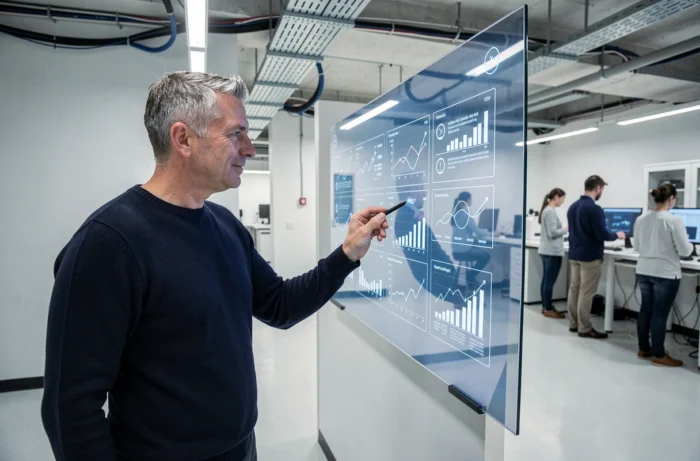
Generative AI is not limited to text production. In 2024, its adoption varies significantly across sectors, with substantial gaps between experimentation and measurable value creation. The table below summarizes the main use cases observed in three key sectors.
| Sector | Main Use | Impact on Existing Systems |
|---|---|---|
| Hospitality | Personalization of the customer experience (recommendations, automated responses) | Integration with PMS and CRM, need for structured data |
| Retail | Generation of product sheets, dynamic pricing management | Connection to ERP, redesign of marketing workflows |
| Industry / Supply Chain | Digital twins, predictive maintenance | IoT sensors coupled with simulation models |
In hospitality, hotels that use generative AI models to handle customer requests before their stay notice an increase in responsiveness. However, integration remains complex: not all property management systems (PMS) were designed to interact with language model APIs.
In retail, automatic content generation speeds up the online publication of catalogs, but the quality of input data directly affects the reliability of outputs. A model fed with incomplete sheets produces approximate descriptions, which harms conversion.
Digital Twins and IoT: Discreet Maturity in Operational Management
Digital twins have moved beyond the pilot stage in several industries. Applied to building management, logistics, or industrial maintenance, they allow for scenario simulation before any physical intervention.
In the hospitality sector, a digital twin of a hotel models energy consumption, customer flows, and equipment wear. This allows for anticipating peak loads and planning maintenance without interrupting operations.
- IoT sensors continuously collect data on temperature, humidity, and occupancy, feeding the digital model in real-time.
- Distributed cloud solutions process this data as close to its source as possible, reducing latency and bandwidth costs.
- Predictive models identify anomalies before they lead to failures, reducing unplanned corrective interventions.
The coupling of IoT and digital twins transforms maintenance management from a burdened expense into a data-driven optimization lever. Companies that have made this leap do not go back.

5G Connectivity and Service Robots: What Low-Latency Networks Change
The deployment of 5G is changing the possible use cases for service robots and augmented reality solutions. In a hotel, a room delivery robot or an automated check-in system requires a stable and fast connection to communicate with central systems.
5G provides the bandwidth and low latency necessary for these devices, but the real bottleneck remains software integration. A robot connected via 5G that does not communicate with the hotel’s PMS remains a gadget. Establishments that leverage these technologies are those that have first unified their management systems.
Augmented reality benefits from the same leverage. In retail, AR applications allow customers to visualize a product in their environment before purchase. Conversely, in hospitality, uses remain experimental: virtual tours of rooms, contextual information about amenities. The return on investment depends on the volume of customers who actually use these features.
- 5G makes autonomous robots technically viable in complex environments (hallways, shared spaces).
- Augmented reality applications become smoother due to reduced network latency.
- Hospitality management systems must evolve to integrate these new customer touchpoints.
The technological trends of 2024 are not just a list of emerging technologies. What distinguishes companies that capitalize on them is their ability to connect these building blocks: structured data, interoperable systems, and regulatory compliance form the foundation upon which each innovation derives its operational value.